

PicoWay® vs. Traditional Q-Switched Laser: What's Actually Different?
If you've been comparing pigmentation or tattoo removal options in Ipoh, you've probably seen "Q-switched" and "picosecond" laser mentioned side by side, often without much explanation of what actually separates them. Here's the real difference — the physics, not just the marketing.
The Core Difference: Pulse Speed
Both technologies work by delivering laser energy in short bursts to break up pigment or tattoo ink into smaller particles the body can naturally clear.
- Q-switched (nanosecond) lasers deliver pulses measured in nanoseconds — billionths of a second.
- PicoWay® (picosecond) lasers deliver pulses roughly 1,000 times faster, measured in picoseconds — trillionths of a second.
That difference in speed changes how the energy interacts with the skin.
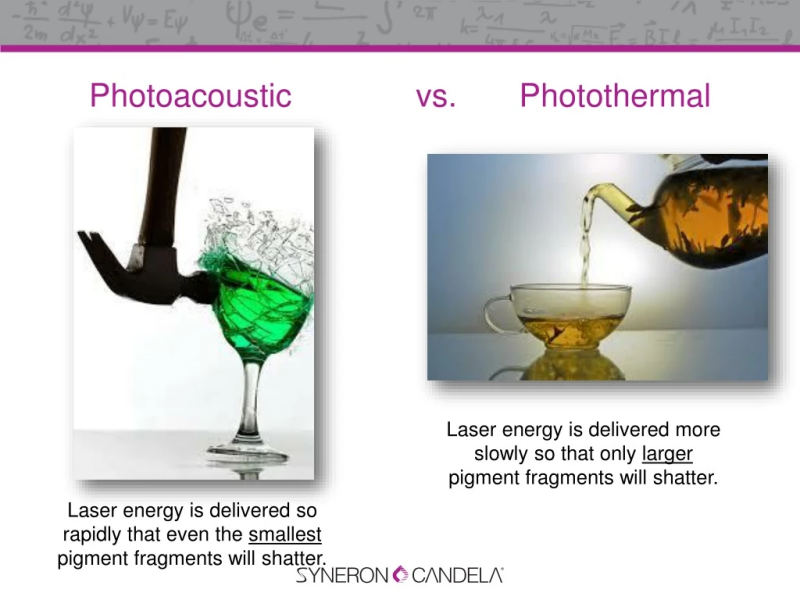
Photothermal vs. Photoacoustic Effect
This is the part that actually matters clinically:
- Q-switched lasers rely more heavily on a photothermal effect — the pigment absorbs the laser energy and heats up, and that heat helps break it apart. The tradeoff is that surrounding tissue absorbs some of that heat too, which is part of why Q-switched treatments carry a higher risk of post-inflammatory hyperpigmentation, especially on darker or more melanin-rich skin.
- PicoWay's much shorter pulse creates a photoacoustic (photomechanical) effect instead — the energy shatters pigment through a rapid pressure wave rather than sustained heat. Less heat transferred to surrounding skin generally means a lower risk of hyperpigmentation, less discomfort, and faster healing.
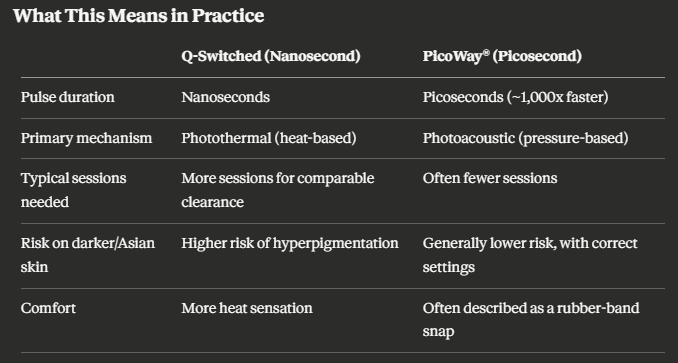
It's worth being fair here: Q-switched lasers aren't obsolete or unsafe when used correctly by a trained provider — they've been a reliable technology for decades, and many good clinical results have come from them. The picosecond advantage isn't magic; it's a genuine difference in how the energy is delivered, which tends to translate into fewer sessions and lower risk of complications, particularly for melanin-rich Asian skin.
Why the Provider Still Matters More Than the Device
No laser, however advanced, replaces proper technique. Settings, wavelength selection, spot sizing, and session pacing all depend on the treating doctor's judgment and experience — not just the machine's specs. A skilled provider on either technology will consistently outperform an inexperienced operator on the newer device.
A Word on Counterfeit Devices
Because "picosecond" and "PicoWay" have become buzzwords in the aesthetic industry, some salons and clinics market unregistered or imitation devices under similar-sounding names. A genuine PicoWay® system is a registered medical device — in Malaysia, this means it should be listed under the Medical Device Authority (MDA), searchable on the official MMDR registry. Always verify before booking, regardless of which technology a clinic offers.
Curious which technology is right for your skin? Book a consultation →
Create Your Own Website With Webador